Every Sunday morning, the same elderly man entered our diner and ordered breakfast for two.
But no one ever joined him.
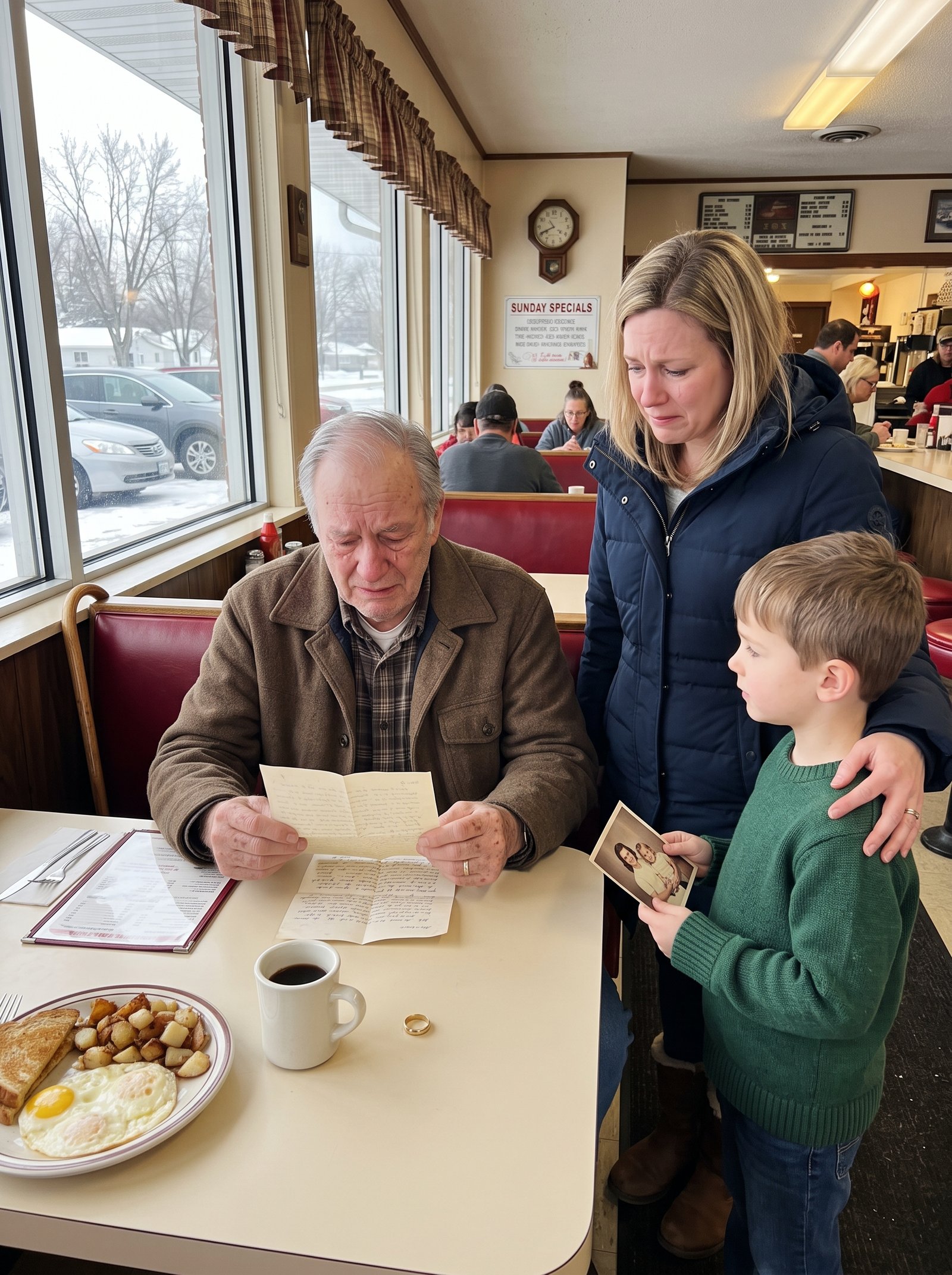
His name was Samuel. He was seventy-eight, always wore the same brown jacket, and walked slowly with a wooden cane.
He sat in booth number six, beside the window.
“Two coffees, two eggs, two pieces of toast,” he would tell me.
I served both meals, even though I knew one plate would remain untouched.
Samuel ate quietly while looking at the empty seat across from him. Before leaving, he carefully wrapped the untouched toast in a napkin and placed it inside his coat pocket.
The other waitresses thought he was lonely.
I assumed the second breakfast was for his late wife, Margaret.
They had been married for fifty-three years before she passed away.
One Sunday, I finally asked him about the empty seat.
Samuel smiled, but his eyes filled with tears.
“Margaret and I ate breakfast here every Sunday for forty-one years,” he said. “She made me promise I wouldn’t stop coming just because she was gone.”
After that, I never questioned the second plate again.
Then, one cold Sunday morning, a young woman entered the diner holding the hand of a little boy.
She looked around nervously until her eyes found Samuel.
The boy was carrying an old photograph.
They walked directly toward booth number six.
“Are you Samuel?” the woman asked.
Samuel slowly stood.
“Yes.”
The little boy placed the photograph beside the untouched plate.
It showed Margaret almost twenty-five years earlier, standing beside a frightened teenage girl outside a hospital.
Samuel stared at it for several seconds.
“I’ve never seen this picture,” he whispered.
The woman began to cry.
“Your wife saved my life,” she said. “But she made me promise not to contact you until this exact date.”
She handed Samuel a sealed envelope.
Across the front, written in Margaret’s familiar handwriting, were the words:
FOR SAMUEL—AT OUR TABLE, WHEN YOU’RE READY.
His hands started trembling.
He opened the envelope and read the first line.
Then he covered his face and began to sob.
I thought Margaret had left him one final goodbye.
But the truth was far more beautiful than any of us expected.
The woman sat beside her son and introduced herself as Emily.
Twenty-five years earlier, Emily had been a seventeen-year-old girl with nowhere to live. Her parents had thrown her out after learning she was pregnant.
She spent one winter night sitting alone outside the emergency entrance of a hospital.
Margaret had been volunteering there.
“She saw me crying and sat beside me,” Emily explained. “She didn’t ask what I had done wrong. She only asked whether I was hungry.”
Margaret bought Emily a meal, helped her find temporary housing and drove her to medical appointments.
She also paid the deposit on a small apartment.
Samuel looked stunned.
“Margaret never told me any of this.”
“She said kindness should never become a performance,” Emily replied.
Over the following years, Margaret continued helping Emily quietly. She assisted with childcare, encouraged her to finish school and helped her apply for a nursing program.
Emily eventually became a pediatric nurse.
The little boy beside her was her grandson, Noah.
Samuel unfolded the letter again and began reading aloud.
My dearest Samuel,
You always told people that I had the generous heart in our marriage. But every act of kindness I gave away began with the love you gave me at home.
Samuel paused, wiping his eyes with the back of his hand.
The letter explained that Margaret had secretly helped several struggling mothers over the years. She never told Samuel because she did not want praise or recognition.
Then came the request she had left for Emily.
Please visit Samuel on the first Sunday after the anniversary of our wedding. He will be sitting in our booth, pretending he is strong enough to eat alone.
Samuel let out a broken laugh.
That Sunday would have been their fifty-fifth wedding anniversary.
Margaret had known exactly where he would be.
The final paragraph made everyone at the table cry.
Samuel, the empty seat does not mean I stopped loving you. It means there is now room for someone else who needs the kindness we built together. Please do not spend the rest of your life only remembering me. Let someone new sit across from you.
For several moments, no one spoke.
Then Noah pointed toward the untouched breakfast.
“Can I sit there?” he asked.
Samuel looked at the empty seat.
For two years, no one had occupied it.
He slowly nodded.
Noah climbed into the booth and took a piece of toast from Margaret’s plate.
“Is this hers?” he asked.
“It was,” Samuel replied. “But I think she saved it for you.”
Emily and Noah began joining Samuel for breakfast every Sunday.
At first, Samuel still ordered two meals.
Soon, he ordered four.
Emily introduced him to several adults whose lives Margaret had quietly changed. Some had become teachers, nurses and parents. One man had opened a small repair shop after Margaret helped him buy his first set of tools.
Samuel had spent years believing his wife’s story ended when she died.
Instead, he discovered that pieces of her were still alive all over town.
Months later, he placed a small wooden box near the diner register. A handwritten card beside it read:
MARGARET’S BREAKFAST FUND — FOR ANYONE WHO NEEDS A MEAL. NO QUESTIONS ASKED.
Customers began leaving a few dollars inside.
Others paid for strangers’ breakfasts.
One Sunday, I saw Samuel sitting in booth number six with Emily and Noah. The empty chair had finally been filled, but Margaret’s wedding ring remained beside the window.
Samuel lifted his coffee cup and looked toward it.
“I kept my promise,” he whispered.
Then Noah told a terrible joke, and Samuel laughed so loudly that everyone in the diner turned around.
For the first time, his laughter did not sound guilty.
It sounded like a man who had finally understood his wife’s last gift:
Love does not ask us to remain alone beside an empty chair.
Sometimes, it sends someone new to sit across from us.