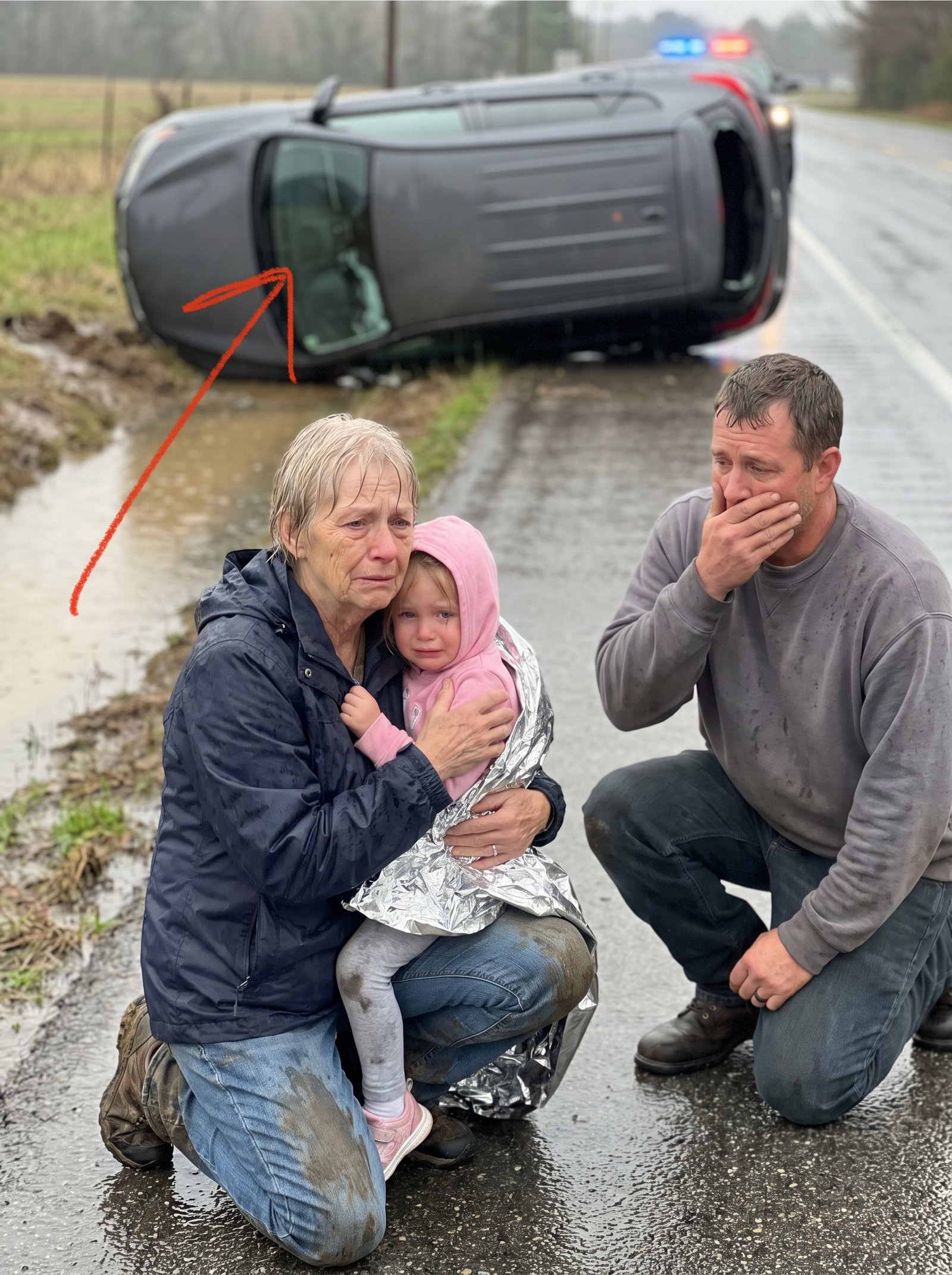
I was driving home from the grocery store when I saw a small SUV on its side in a flooded ditch.
Cars were slowing down.
Nobody was getting out.
Then I saw a tiny hand against the rear window.
I pulled over.
My name is Linda. I’m seventy-two, and my knees haven’t been good for years.
But when I heard a child screaming, I forgot about my knees.
The driver’s door was trapped against the mud.
Water was rising around the back seat.
Inside, a little girl was strapped into her car seat. A young woman in front was unconscious but breathing.
I tried the rear door.
It wouldn’t move.
I grabbed a rock and broke the side window.
Another driver finally ran down to help.
We pulled the little girl through first.
She wrapped herself around my neck.
“Don’t leave Mommy.”
“I won’t.”
Firefighters arrived minutes later and removed her mother.
I sat beside the road wrapped in an emergency blanket, holding the child while she cried.
Then a pickup truck arrived.
A man jumped out and ran toward us.
“Emma!”
The girl lifted her head.
“Daddy!”
He dropped beside us.
At first, he saw only his daughter.
Then he looked at me.
His face changed.
“Linda?”
I stared back.
“David?”
He was forty-four now.
But I knew those eyes.
Thirty-seven years earlier, David had lived in my home.
He was seven.
His mother had been hospitalized after a serious accident, and his father could not be located.
A social worker asked whether my husband and I could keep him for a few nights.
He stayed eleven months.
David arrived carrying his clothes in a grocery bag.
For two weeks, he slept wearing his shoes because he thought someone might suddenly tell him to leave.
He hardly spoke.
Then one night, a severe storm flooded our basement.
David became hysterical.
That was when we learned why.
Years earlier, he had been trapped in a flooded vehicle with his mother.
He survived.
She did not.
Nobody had helped him understand what happened.
That night, I sat beside his bed until morning.
“You don’t have to be brave here,” I told him. “You just have to stay.”
Slowly, David changed.
He started laughing.
He joined Little League.
He stopped sleeping in his shoes.
Eventually, relatives in another state were approved to raise him.
Before he left, I gave him our phone number.
“Call anytime.”
He promised.
But our lives separated.
His relatives moved again.
My husband changed jobs.
Our phone number changed.
Years became decades.
I thought of David often, but I never knew where he went.
Now he was kneeling beside a flooded ditch while his daughter clung to my jacket.
“You saved her the same way you saved me,” he said.
Then he reached into his wallet.
Inside was a small piece of yellow construction paper covered in clear tape.
I recognized it immediately.
When David was seven, I had drawn a crude little house on it.
Underneath, I had written:
If you ever feel scared, remember there is a house where someone wanted you.
“You kept that?”
“Every wallet I’ve owned.”
I began crying.
David told me he had searched for my family for years.
He became a high-school guidance counselor.
He married a woman named Megan.
They had Emma.
“I wanted her to know you,” he said. “I wanted her to know why her dad takes kids seriously when they say they’re scared.”
Megan survived the crash.
She had a concussion and several injuries, but doctors expected her to recover.
That evening, David drove me home.
Emma came too.
When we reached my porch, she saw the old wooden swing.
“Did Daddy sit there when he was little?”
I laughed.
“He practically lived there.”
David stood silently in the yard.
My husband had died nine years earlier.
My own children lived in other states.
For years, the house had been much quieter than I liked to admit.
David walked onto the porch and touched the doorframe.
His childhood height mark was still there.
I had never painted over it.
He covered his face.
“You remembered me.”
“Of course I remembered you.”
A week later, Megan came home from the hospital.
The first place their family visited was my house.
Emma brought me a drawing.
It showed a crooked yellow house.
Five people stood outside it.
Her mother.
Her father.
Emma.
Me.
And my late husband, whom she had only seen in photographs.
At the bottom she had written:
GRANDMA LINDA’S HOUSE.
I stared at the word Grandma.
David noticed.
“I hope that’s okay.”
I reached across the table and took his hand.
“It took you thirty-seven years to come back. I’m not arguing about the name.”
We all laughed.
David and his family now visit every Sunday.
Emma’s bicycle sits in my garage.
Megan has a key to the house.
And David still carries that taped piece of yellow paper in his wallet.
People called what happened beside that ditch a rescue.
Maybe it was.
But every time Emma runs through my front door yelling “Grandma,” I think about the seven-year-old boy who once slept in his shoes because he believed every home was temporary.
Thirty-seven years ago, I told him there would always be one place where somebody wanted him.
It took a flooded ditch, a broken window, and one frightened little girl to finally bring him back to it.