For thirty-four years, my mother kept my brother’s Army footlocker locked in the corner of his childhood bedroom.
She refused to let anyone open it.
My brother Michael joined the Army when he was twenty-one.
The morning he left, Mom stood on the front porch holding his face between her hands.
“Come home to me,” she whispered.
Michael smiled.
“I always do.”
Eight months later, two uniformed officers knocked on our door.
Michael had been killed while serving overseas.
He was twenty-two.
After the funeral, the Army returned his belongings in a dark-green metal footlocker.
Mom carried it into his bedroom, locked the door, and placed the key inside a small silver locket she wore around her neck.
“Michael wanted this kept safe,” she said.
We never understood what she meant.
For more than three decades, his room remained almost unchanged.
His baseball glove sat on the shelf. His high-school photograph remained beside the bed. The footlocker gathered dust beneath the window.
Whenever I suggested opening it, Mom gave me the same answer.
“Not yet.”
Then, on Mom’s eighty-second birthday, someone knocked on the door.
A woman I had never seen before stood on the porch with a little girl beside her.
The child looked about nine years old.
Around her neck hung a pair of old military dog tags.
One carried my brother’s name.
My mother saw the tags and gripped the doorway.
“Where did you get those?” she whispered.
The woman’s name was Rachel.
“Michael gave them to my father the night he saved his life,” she said.
The little girl stepped forward and held out a faded envelope.
“He told Grandpa that if he couldn’t return it himself, someone from our family had to bring this to Mrs. Carter on her eighty-second birthday.”
Mom stared at the envelope.
Her full name was written across the front in Michael’s handwriting.
Then the little girl said something that made Mom reach for the silver locket she had worn for thirty-four years.
“Mr. Michael said the key would still be inside.”
Mom removed the key.
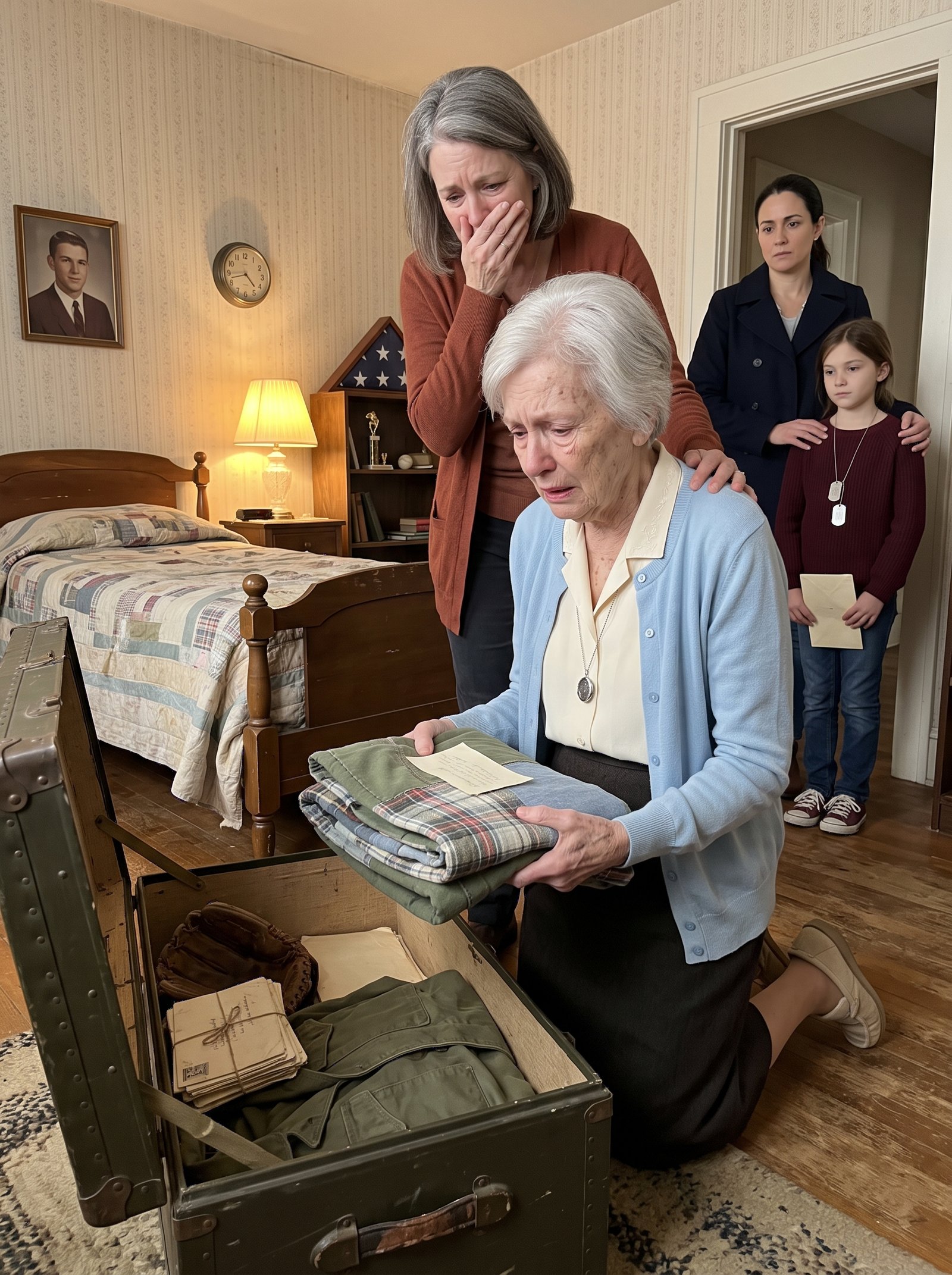
For the first time since Michael died, she walked into his bedroom and knelt beside the footlocker.
Her hands trembled as she placed the key in the lock.
The lid opened with a low metallic click.
On top was a folded Army jacket, a stack of letters, and a small wooden box marked with my name.
Underneath them was a handmade baby quilt.
Mom lifted it with both hands and began to cry.
She recognized the fabric immediately.
The green squares had been cut from one of Michael’s field shirts. The blue pieces came from the shirt he wore on his final birthday at home.
Stitched into one corner was our family name.
“Michael couldn’t sew,” I whispered.
“My father could,” Rachel replied.
Her father, David, had served in Michael’s unit.
During an attack, David was badly injured and unable to walk. Michael carried him to safety and stayed beside him until help arrived.
While they waited, the two young soldiers spoke about home.
David said he hoped to marry his high-school sweetheart and have children.
Michael told him that if he ever had a niece or nephew, he wanted the child to know that an uncle had loved them before they were born.
Michael did not survive the following day.
David returned home carrying Michael’s spare dog tags, several letters and pieces of clothing Michael had asked him to protect.
Over the following months, David used those pieces to sew the small quilt.
“He wanted to bring it here immediately,” Rachel explained. “But Michael’s instructions were very specific.”
She handed me the wooden box.
Inside was a hospital bracelet bearing my name.
I had been pregnant when Michael deployed, but I lost the baby shortly after his funeral.
Mom and I rarely spoke about it.
Beside the bracelet was a photograph of Michael holding a pair of tiny baby shoes I had mailed to him.
At the bottom of the box was a letter.
Dear little one,
I don’t know whether you will be a boy or a girl. I only know that I already love being your uncle.
I stopped reading.
My hands shook so badly that Rachel took the letter and continued.
Michael had written about teaching my child to play baseball, taking them fishing and telling embarrassing stories about their mother.
Then came the paragraph that explained the thirty-four-year wait.
If the baby does not get the chance to use this quilt, keep it safe until Mom turns eighty-two—the age Grandma Rose was when she said a family is never finished growing. On that birthday, give it to a child who can carry our story forward.
Michael had known about our great-grandmother Rose, who lived to eighty-two and spent her final years making quilts for children in need.
He had chosen Mom’s birthday to honor her.
The little girl with the dog tags was Rachel’s daughter, Emma.
David had died the previous year. Before his death, he gave Rachel Michael’s letter and made her promise to complete the delivery.
Emma stepped closer to Mom.
“Grandpa said the quilt was supposed to find a child on this day.”
Mom looked at me.
For years, she had believed the locked footlocker contained only grief.
Instead, Michael had left instructions for turning that grief into something useful.
We could have given the quilt to Emma.
But Rachel explained that her father had one final suggestion.
Near our town was a family shelter where parents and children often arrived with almost nothing.
That afternoon, all four of us visited it.
The shelter director introduced us to a young mother named Nicole and her six-month-old son, Daniel.
They had left an unsafe home that morning. Everything they owned fit inside two plastic bags.
Mom sat beside Nicole and placed the quilt around the baby.
“This was made by two soldiers,” she explained. “One saved the other, and both wanted it to keep a child warm.”
Nicole looked down at the green and blue fabric.
“Why us?”
Mom touched Michael’s dog tags around Emma’s neck.
“Because my son believed family could grow even among strangers.”
Before leaving, Emma removed one of the dog tags.
She placed it gently in Mom’s palm.
“Grandpa said this one belonged back with Michael’s mother.”
Mom closed her fingers around it.
For the first time in thirty-four years, the footlocker did not return to the corner of Michael’s bedroom.
We moved it into the living room and filled it with fabric, thread and letters from people Michael’s story had touched.
Mom began sewing again.
With help from Rachel and Emma, she made small quilts for military families, widows and children entering shelters.
Each one contained a green square cut from donated uniforms.
A small card accompanied every quilt:
Made in memory of someone who came home through the kindness they left behind.
Mom had protected Michael’s footlocker because she feared opening it would mean losing the final part of him.
Instead, opening it brought him back into our family’s life.
Not as the twenty-two-year-old soldier who never returned—but as an uncle, a son and a promise that had waited thirty-four years to be kept.