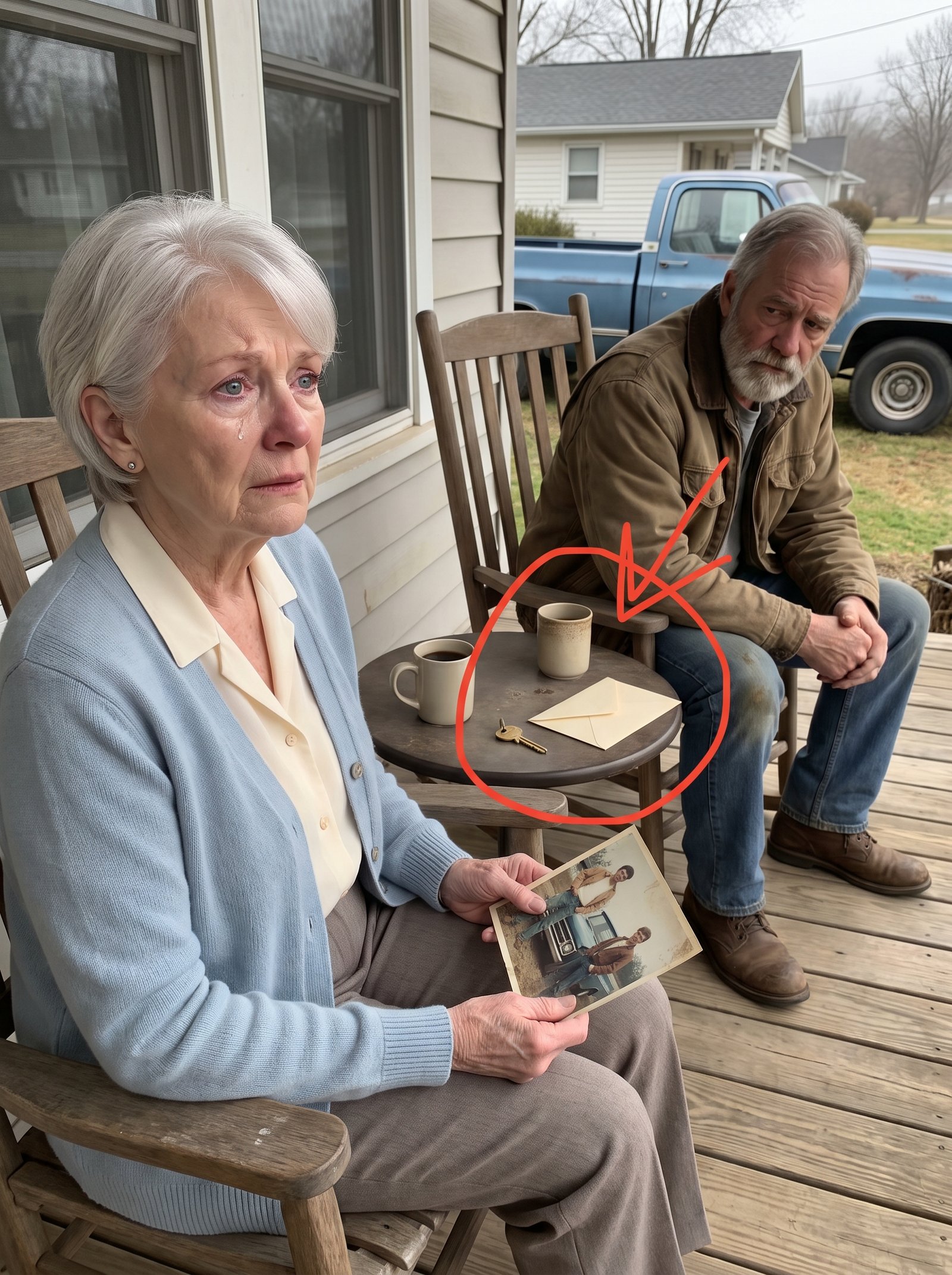
Every Thursday afternoon, an elderly veteran came into my flower shop and bought the same twelve yellow roses.
But he never told me who they were for.
His name was Walter. He was eighty-one, walked with a slight limp, and always wore a faded Navy cap covered with small service pins.
“Nothing fancy,” he would say. “She always liked them simple.”
He paid in cash, carefully counted every dollar, and asked me to wrap the roses in plain brown paper.
At first, I assumed his wife was waiting at home.
Then one rainy Thursday, I offered to carry the flowers to his car.
Walter shook his head.
“I don’t have a car anymore. I walk from here.”
“Is it far?”
“About two miles.”
I looked at his cane and the heavy rain outside.
Without asking permission, I closed the shop for ten minutes and drove him.
He directed me to a quiet cemetery on the edge of town.
That was when I understood.
His wife, Evelyn, had been gone for six years.
Walter placed the roses beside her headstone, brushed away the wet leaves, and sat on a small folding chair.
“I promised her flowers every Thursday,” he said. “Fifty-seven years ago, Thursday was the day she agreed to marry me.”
After that, I began driving him to the cemetery whenever the weather was bad.
For nearly a year, the routine never changed.
Then one Thursday, Walter didn’t come.
He missed the following week too.
I called the number he had written on an old order card, but it had been disconnected.
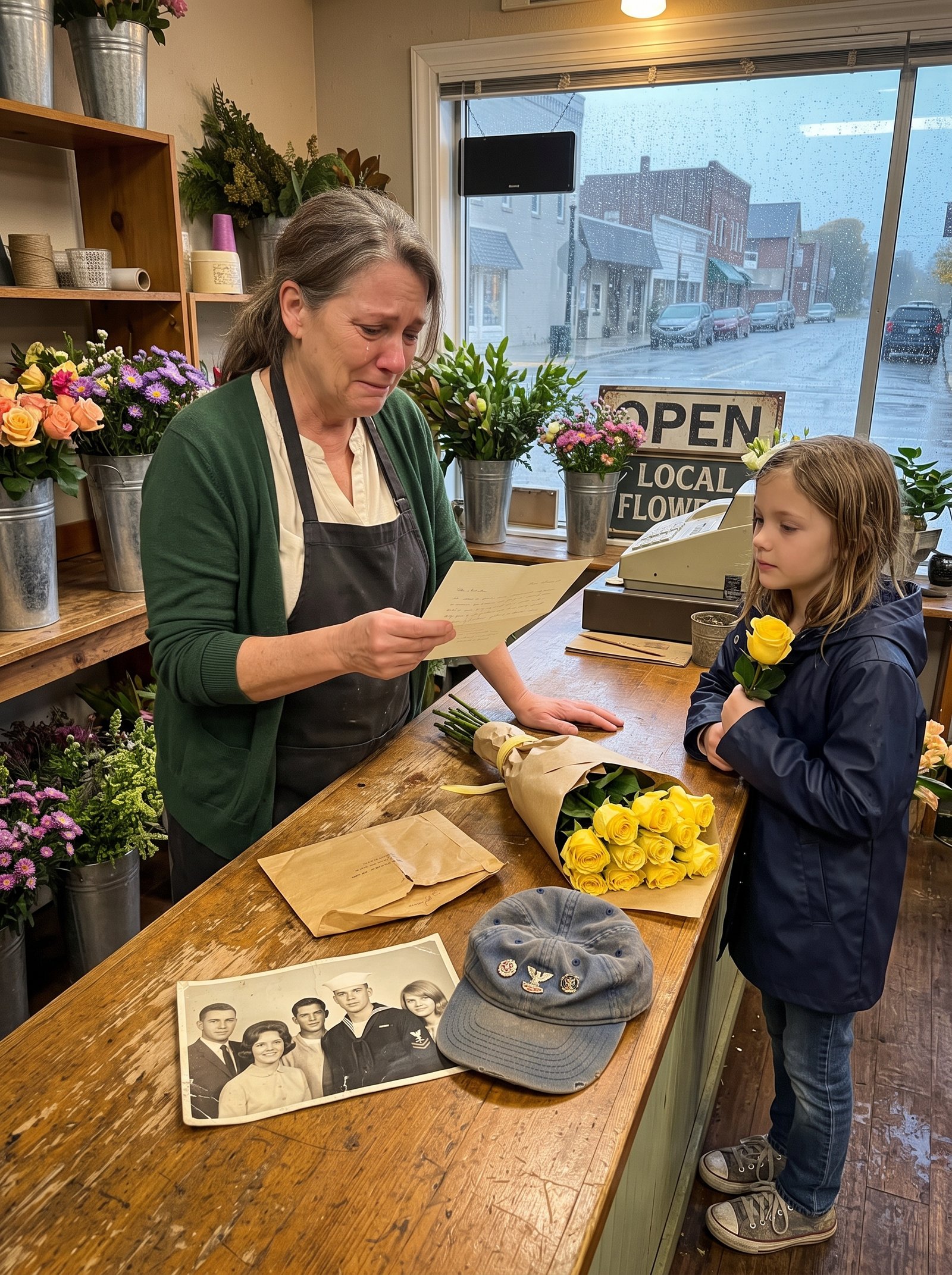
Three weeks later, a little girl entered my shop holding a brown envelope and one yellow rose.
She looked about ten years old.
“Are you the lady who made Mr. Walter’s flowers?” she asked.
My stomach dropped.
“Yes. Is he all right?”
The girl didn’t answer.
Instead, she placed the envelope on the counter.
Written across the front in Walter’s shaky handwriting were the words:
FOR THE FLOWER LADY WHO NEVER LET ME WALK ALONE.
Before I could open it, the girl pointed to a small photograph attached to the envelope.
It showed Walter as a young sailor standing beside Evelyn—and another young couple I didn’t recognize.
“That’s my great-grandmother,” the girl whispered, pointing to the second woman.
Her name was Sophie.
She told me Walter had been living at a veterans’ care home for the past few months. His health had become worse, but every Thursday he still asked someone to help him prepare twelve yellow roses.
“He said the flowers weren’t only for Miss Evelyn,” Sophie explained.
I looked again at the photograph.
Walter and Evelyn were standing beside Sophie’s great-grandparents, Robert and Anna.
More than fifty years earlier, the four of them had lived in the same military town.
Walter and Robert had served together in the Navy. Their wives became close friends while the men were deployed.
Before one dangerous assignment, Robert pulled Walter aside.
“If I don’t come home, promise me Anna and the baby won’t be alone.”
Walter promised.
Robert never returned.
Anna was twenty-two years old and raising an infant son by herself.
Walter and Evelyn could not replace Robert, but they refused to let his family disappear from their lives.
They repaired Anna’s leaking roof, drove her to medical appointments and watched her son while she worked evening shifts.
Every year on Robert’s birthday, they brought Anna twelve yellow roses—the same flowers Robert had given her on their first date.
Anna’s son eventually grew up, married and had children of his own.
Sophie was his granddaughter.
“Mr. Walter kept checking on our family even after my great-grandmother died,” Sophie said. “Dad says we wouldn’t have the life we have without him and Miss Evelyn.”
I opened Walter’s envelope.
The first line made me grip the counter.
Dear Susan, if Sophie has brought you this letter, my Thursdays have finally run out.
Walter had died peacefully four days earlier.
He had asked Sophie’s family not to contact me until after his funeral because, in his words, he did not want me closing the flower shop and losing a day of business because of him.
Even at the end, he had been worrying about someone else.
I continued reading.
For fifty-seven years, yellow roses helped me keep two promises: one to my best friend and one to my wife. But promises should not be buried with the people who made them. They should be handed forward.
Inside the envelope was enough money to purchase twelve roses each Thursday for an entire year.
Walter’s final request was simple.
He did not want the roses placed on his grave.
He wanted six delivered to a lonely resident at the veterans’ care home and six given to someone who had recently lost a spouse.
Do not choose the person with the saddest story, Walter had written. Choose the person who looks as though nobody remembered them that day.
At the bottom of the letter, he had added one more sentence.
And please let Sophie choose the first person. She needs to learn that keeping a promise can become a family tradition.
The following Thursday, Sophie returned to the shop.
Together, we wrapped twelve yellow roses in brown paper.
At the veterans’ care home, she chose an eighty-six-year-old woman named Helen, whose husband had died the previous winter.
Helen was sitting alone beside a window when Sophie handed her the flowers.
“Who sent these?” Helen asked.
Sophie thought for a moment.
“A sailor who always kept his promises.”
Helen pressed one rose to her chest and began to cry.
We gave the other six roses to a man named Charles, who came to the cemetery each morning to sit beside his wife’s grave.
When Sophie explained Walter’s request, Charles removed his hat.
“I served in the Navy too,” he said quietly. “I wish I had known him.”
A year passed, but the flowers did not stop.
Customers who heard Walter’s story began leaving donations at the shop. Some paid for one rose. Others paid for an entire bouquet.
I placed a plain wooden box near the register with a small card:
WALTER’S THURSDAY ROSES — FOR SOMEONE WHO THINKS THEY HAVE BEEN FORGOTTEN.
Sophie still visits every month.
She is older now, but she always carries the same faded photograph of Walter, Evelyn, Robert and Anna.
Sometimes she helps me choose the next recipient.
Sometimes she delivers the flowers herself.
Walter believed his Thursdays had run out.
He was wrong.
Every week, somewhere in our town, a stranger receives a yellow rose because an old sailor kept a promise for more than fifty years.
And every time one is delivered, Walter’s promise begins again.