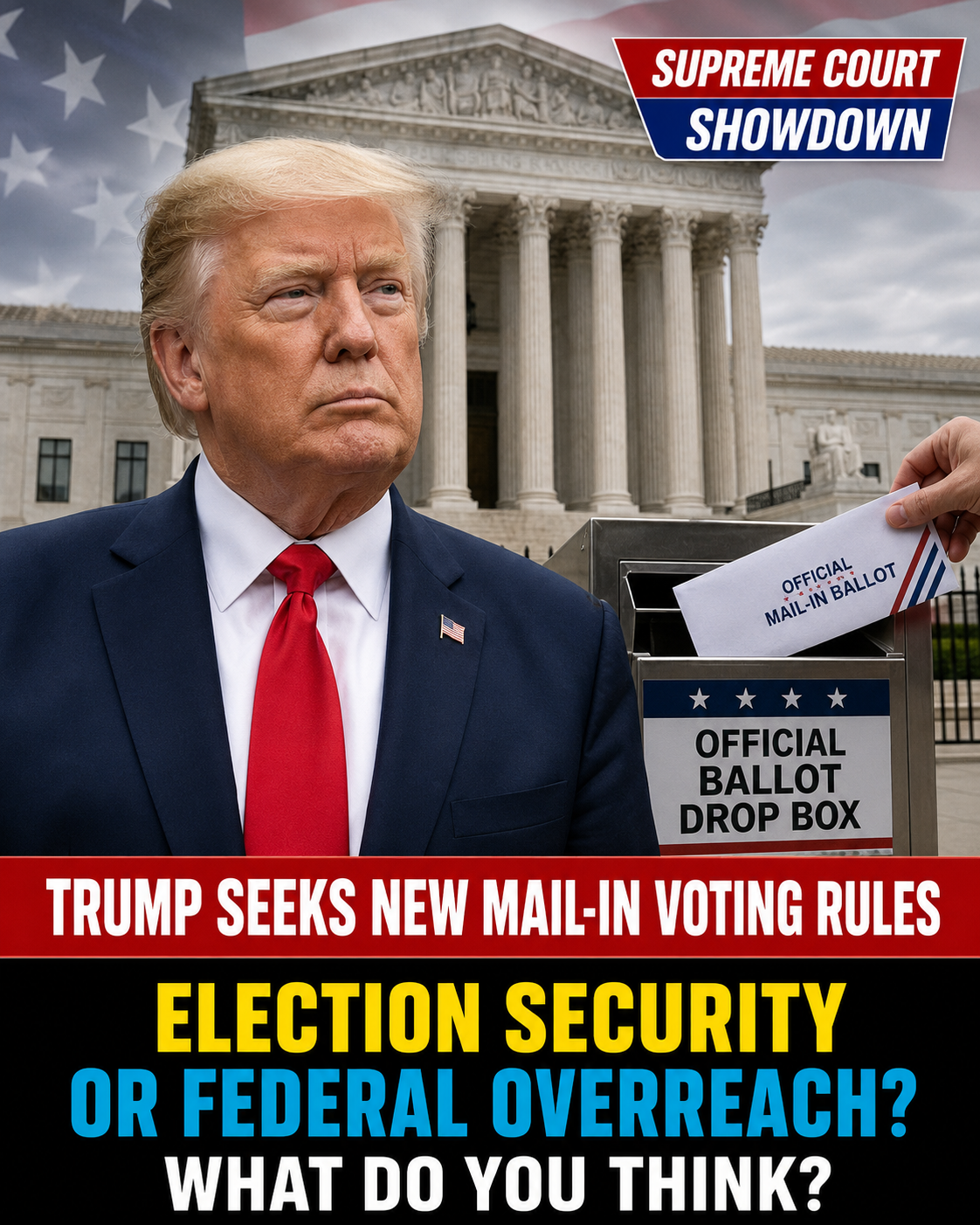
The Trump administration has asked the U.S. Supreme Court to allow a contested election order affecting mail-in voting to take effect before the November midterm elections.
The request could lead to an important decision about presidential power, election security and the authority traditionally held by Congress and individual states.
The executive order would establish a federal process for verifying voter eligibility, require stronger tracking of ballots sent through the mail and place financial pressure on states that refuse to comply with the new requirements.
Supporters of the administration say the changes would create clearer national standards and increase public confidence in American elections.
Opponents argue that the president is attempting to exercise authority the Constitution does not give the executive branch.
Why the order is currently blocked
A federal judge blocked major portions of the order before they could take effect.
An appeals court subsequently allowed that ruling to remain in place.
Democratic officials representing 23 states and Washington, D.C., have challenged the administration’s plan.
They argue that election procedures are primarily established by state legislatures and Congress—not rewritten through a presidential executive order.
The administration has now asked the Supreme Court to intervene quickly, saying election officials need enough time to prepare before voting begins.
The legal dispute and the administration’s Supreme Court request were reported this week as preparations accelerate for the 2026 midterms.
What would the order change?
One of the most controversial provisions would establish a federal state-citizenship list intended to identify people eligible to receive mailed ballots.
The administration also wants stronger systems for tracking ballots as they travel through the postal system.
States that refuse to adopt the requirements could risk losing certain federal election funds.
The Trump administration describes the measures as safeguards designed to protect election integrity and reduce public suspicion surrounding mailed ballots.
Some Republican voters and officials have argued for years that national elections need stricter verification requirements.
However, critics say a new federal list could contain errors, fail to include eligible voters or create additional steps that prevent lawful ballots from being delivered on time.
They also warn that introducing a new system shortly before a major election could cause administrative confusion.
Why the timing matters
Every seat in the U.S. House of Representatives and roughly one-third of the Senate will be contested in the November 2026 midterms.
The results will determine whether Republicans retain control of Congress during the final two years of President Trump’s second term.
Mail-in voting could play an important role, especially among seniors, people with disabilities, military families, rural residents and voters who cannot easily visit a polling location.
That means even technical changes involving eligibility lists, delivery rules or ballot tracking could affect large numbers of voters.
Supporters say that is exactly why stronger rules should be introduced.
Opponents say it is why the government should avoid changing established procedures so close to Election Day.
The larger constitutional question
The dispute is not limited to whether mail-in voting is good or bad.
At its center is a broader question:
How much power does a president have to change the way federal elections are administered?
The Constitution gives states an important role in determining the time, place and manner of congressional elections, while Congress retains the ability to establish or alter national rules.
Presidents oversee federal agencies, but they do not traditionally control every part of state election administration.
The Supreme Court could allow the order to take effect temporarily, keep it blocked while the lawsuit continues or issue a narrower decision applying only to certain provisions.
A temporary ruling would not necessarily settle the entire constitutional dispute.
However, it could determine which rules election officials must follow during the upcoming midterms.
What happens next?
The administration wants the justices to act quickly enough for election agencies and the Postal Service to implement the proposed system.
The states challenging the order are asking the Court to leave the lower-court block in place.
Whatever the justices decide, the ruling is likely to become a major political issue as both parties campaign for control of Congress.
Republicans are expected to frame the debate around election security, verification and public confidence.
Democrats are expected to focus on voting access, presidential overreach and the risk that eligible voters could be excluded.
For millions of Americans, the most important question may be more practical than political:
Will voting by mail become safer and more trustworthy—or more difficult and confusing?
That is the question the Supreme Court may soon have to answer.