My children sold my house while I was recovering in the hospital.
They thought I didn’t know.
My name is Ruth. I am seventy-nine years old, and I had lived in that little white house for fifty-two years.
My husband, Frank, built the front porch with his own hands.
We raised three children there.
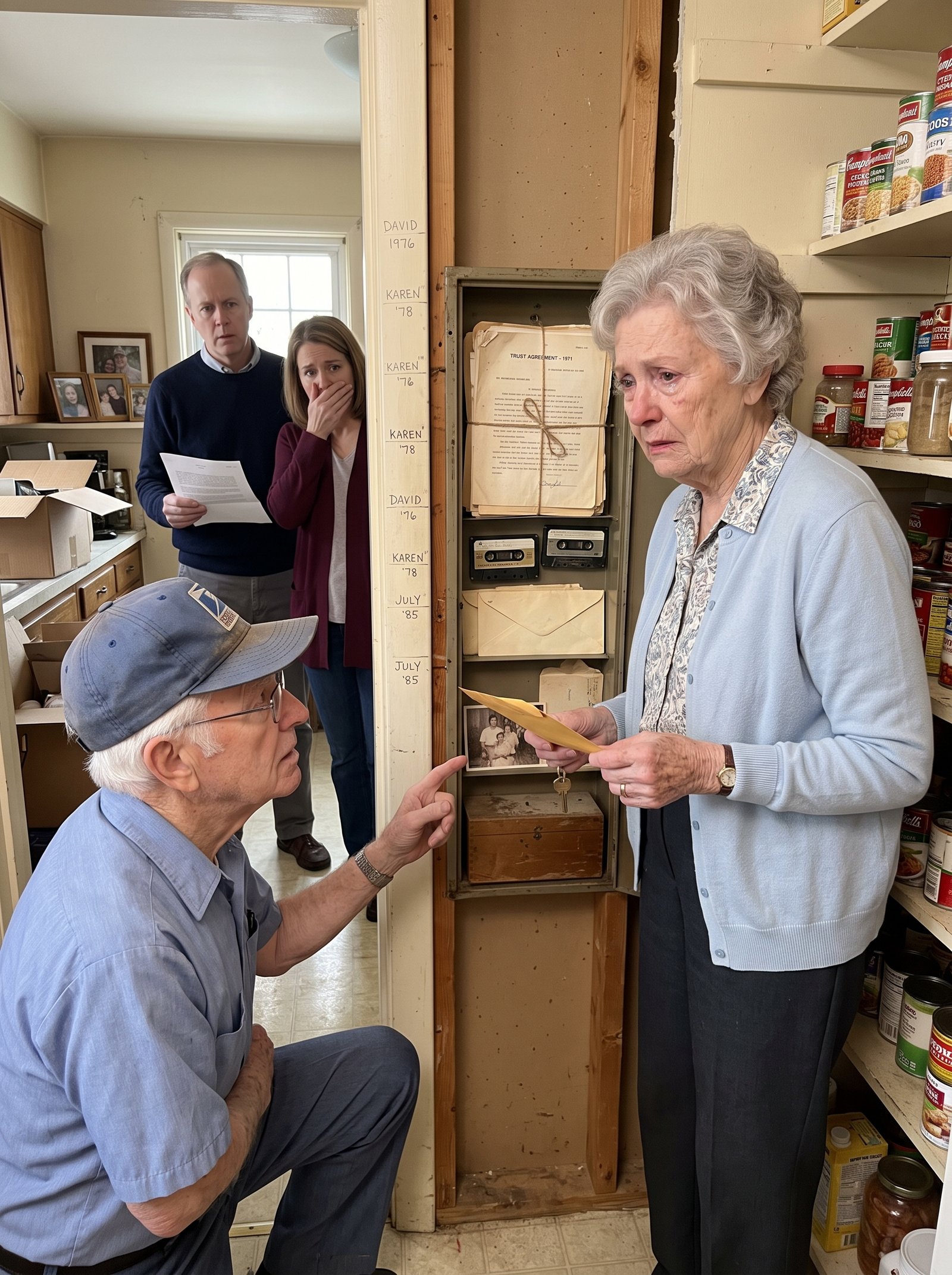
Their heights were still marked in pencil inside the pantry door. Frank’s work boots remained beneath the basement stairs, exactly where he left them before he died.
After I fell and broke my hip, my children insisted I stay at a rehabilitation center.
“It’s only temporary, Mom,” my oldest son, David, said.
But one afternoon, I overheard him speaking in the hallway.
“The closing is Friday. She’ll be better off in assisted living.”
I waited until he entered my room.
“You sold my house?”
David stopped walking.
My daughter Karen looked down at the floor.
They said the stairs were dangerous and the repairs were becoming expensive.
“You signed the papers,” Karen reminded me.
They had placed them among my medical forms while I was taking strong pain medication.
I had trusted them.
The new owners were scheduled to receive the keys in three days.
I asked for one final afternoon at home.
When we arrived, cardboard boxes covered the living room. Family photographs had been removed from the walls. Frank’s chair was marked for donation.
Then someone knocked.
It was Mr. Bennett, our eighty-six-year-old retired mailman.
In his hands was an old canvas postal bag.
“I heard the house was sold,” he said. “There’s something Frank asked me to return before you left.”
From the bag, he removed a yellowed envelope.
Across the front, in Frank’s handwriting, were the words:
FOR RUTH—ONLY IF OUR CHILDREN EVER TRY TO TAKE HER HOME AWAY.
Inside was a brass key and a photograph of Frank standing beside the pantry door.
On the back, he had written:
THE HOUSE DOESN’T BELONG TO THE PERSON HOLDING THE DEED. IT BELONGS TO THE PERSON WHO REMEMBERS WHAT IS BEHIND THIS WALL.
Mr. Bennett removed a narrow wooden panel beside the height marks.
Behind it was a small metal compartment.
The key opened it.
Inside were legal papers, three letters and a cassette tape.
The top document carried the name of Mr. Bennett’s late wife, Anna.
David’s face hardened.
“Did your family secretly own this house?”
Mr. Bennett did not argue.
Instead, he removed a small cassette player from his bag and inserted Frank’s tape.
My husband’s voice filled the pantry.
“Ruth, if you are hearing this, someone has decided your age means your wishes no longer matter.”
I pressed one hand against the wall.
Frank explained that in 1974, shortly after we bought the house, he suffered a serious workplace injury.
We had three young children and almost no savings.
The bank was preparing to take the property.
Anna Bennett had recently inherited money from her father. Without telling anyone in town, she paid what we owed.
“She said children should not lose their home because their father got hurt,” Frank said.
Anna refused repayment.
Instead, she and Frank created a legal protection agreement.
I had the right to remain in the home for my entire life. The property could not be transferred without my independent approval and consent from Anna’s designated family representative.
That representative was Mr. Bennett.
The sale my children had arranged was invalid.
David lowered the document.
Karen began to cry.
Then Frank spoke directly to them.
“David, Karen and Michael, your mother worked nights when money was short. She watched your children, opened her door after every argument, and never asked whether helping you was convenient.”
No one moved.
“A home is not an asset simply because your mother became old. Before deciding where she belongs, remember who spent a lifetime making sure you always had somewhere to belong.”
Frank’s voice was calm.
That made every word more painful.
My children had not included my youngest son, Michael, in the sale. He lived several states away and knew nothing about it.
The three letters were addressed to each of them.
David opened his first.
Frank reminded him of the year he lost his job and moved back home with his wife and two children.
Karen’s letter recalled the months I cared for her after surgery.
Michael’s thanked him for always asking what I wanted instead of deciding for me.
David sat down on a pantry stool.
“I thought I was solving a problem,” he whispered.
“You were solving your problem,” I replied. “The house was inconvenient for you.”
Inside the compartment was one final document.
Frank had created an option for me.
I could remain in the house for life.
Or I could convert it into a shared home for older women who had nowhere safe to go.
For years, Frank had watched widows in our town lose their homes after illness, financial pressure or family disputes.
He wanted me to have companionship without losing control of my own life.
The decision was mine alone.
David offered to cancel everything and repair the house.
Karen begged me to forgive them.
I did forgive them eventually.
But forgiveness did not mean pretending nothing had happened.
The sale was stopped the following morning.
I returned home after rehabilitation, but I did not live there alone.
With help from Mr. Bennett, Michael and a local nonprofit, we renovated the first floor and added safer handrails, wider doorways and an accessible bathroom.
Three women moved in during the following year.
Helen was an eighty-one-year-old widow whose apartment building had been sold.
Dorothy had spent most of her savings caring for her husband during his final illness.
Maria had been living in a motel after a dispute with relatives.
Each woman brought one chair, several photographs and a lifetime of stories.
We named the house Anna’s Porch.
David repaired the roof himself.
Karen began visiting every Tuesday and cooking dinner for everyone.
Trust returned slowly—not because they apologized once, but because they learned to listen.
The pencil marks remain inside the pantry door.
Below the names of my children, we have added the names of every grandchild and great-grandchild who visits.
Frank’s tape is stored in the metal compartment, but the wooden panel is no longer hidden.
Beside it hangs a small framed message:
Growing older does not erase a person’s right to choose where—and how—they belong.
My children once believed the kindest thing was to decide my future for me.
Frank’s final gift taught all of us something different.
A house becomes a home through love.
But love without respect can still lock someone out of their own front door.