At my father’s funeral, a stranger in a worn brown coat stood in the back row and quietly called him “Dad.”
My mother nearly collapsed when she saw him.
Dad was eighty-six when he died.
To everyone in our small town, George Miller was a retired carpenter who repaired porch steps, built church benches, and rarely accepted money from someone struggling.
To me, he was simply Dad.
He taught me how to ride a bicycle, inspected my car long after I had children of my own, and called every Sunday at exactly seven.
Dad and Mom were married for sixty-one years.
I believed I knew everything about his life.
Then the stranger appeared.
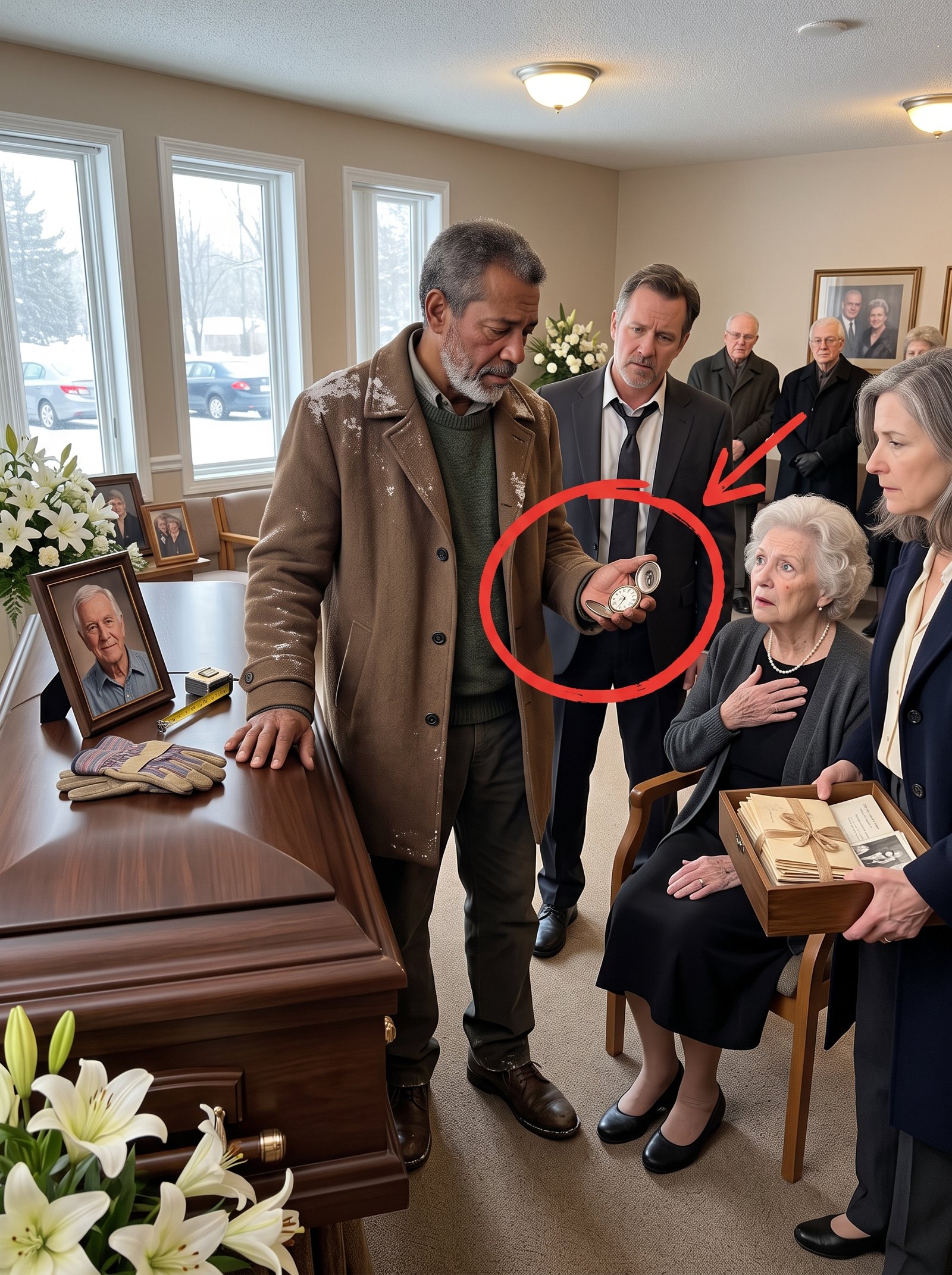
He looked about sixty-five. His gray beard was uneven, his shoes were wet from the snow, and he held an old wooden box against his chest.
He remained near the back until the funeral service ended.
Then he approached the casket and placed one hand against the wood.
“Goodbye, Dad,” he whispered.
My brother stepped forward.
“Who are you?”
The man looked frightened.
Before he answered, Mom noticed the silver pocket watch hanging from his hand.
Her face turned white.
“Where did you get that?”
The watch had belonged to Dad’s father.
For my entire childhood, it remained locked inside Mom’s dresser.
Whenever we asked about it, she gave the same answer.
“That watch carries a promise your father was never able to keep.”
Now it was in a stranger’s hand.
The man opened it.
Inside was a tiny photograph of Dad as a young man standing beside a Black teenage boy in front of a woodworking shop.
“My name is Raymond,” he said. “George wasn’t my biological father. But he was the only man who ever chose to be one.”
Mom lowered herself into a chair.
Raymond handed me the wooden box.
Inside were fifty-four birthday cards, all written by Dad.
One for every year since Raymond disappeared.
None had been mailed.
Underneath them was a letter addressed to Mom.
ELLEN, I KEPT MY PROMISE TO THE BOY. I’M SORRY I COULDN’T KEEP IT WITHOUT BREAKING YOUR HEART.
Mom began crying before she opened it.
Raymond had been fourteen when Dad found him sleeping inside an abandoned workshop.
His mother had died. His father was in prison, and no relative was willing to take him.
Dad brought him food and offered him small jobs sanding cabinet doors.
Eventually, he allowed Raymond to sleep in the room above the shop.
For almost three years, Dad treated him like a son.
He attended school meetings, taught him carpentry, and opened a savings account in Raymond’s name.
Mom knew.
She packed Raymond’s lunches and washed the work clothes he left behind.
“I loved him too,” she whispered. “That’s what made me so afraid.”
In 1969, someone attacked the workshop during the night.
The windows were broken. Threats were painted across the door, and Dad was warned that his family would suffer if Raymond remained.
Dad wanted to bring Raymond permanently into our home.
Mom was pregnant with my brother.
She begged Dad to send Raymond somewhere safer until the danger passed.
Raymond overheard them arguing.
He left before sunrise.
“I thought Mrs. Miller didn’t want me,” he said.
Mom covered her face.
“I wanted you alive.”
Dad searched for months but could not find him.
Every year afterward, he wrote Raymond a birthday card.
He stored each card inside the wooden box, hoping he would someday have an address.
Raymond built a life in another state.
He became a carpenter, married, and opened a small repair business.
But after his wife died, everything began falling apart.
Medical bills forced him to close the shop. He lost his apartment and eventually moved into temporary housing.
Two years before Dad died, Dad found Raymond’s name in a community newsletter about a shelter’s woodworking program.
He traveled hundreds of miles to see him.
Their first meeting lasted nearly six hours.
“George apologized for not protecting me,” Raymond said.
Mom looked toward the casket.
“He never forgave himself.”
Raymond shook his head.
“He didn’t need forgiveness. He gave a scared boy the first safe place he ever had.”
Dad had wanted to bring Raymond home immediately.
But Raymond refused.
He did not want Mom to believe he had returned for money, and he did not want us meeting him while Dad’s health was failing.
Instead, Dad gave him the pocket watch.
Inside the wooden box was also a legal document.
Dad had left Raymond his original woodworking shop, which had remained unused for nearly fifteen years.
My brother stiffened.
“That property is worth a lot now.”
Raymond nodded.
Then he handed the document back to me.
“I’m not keeping it.”
Dad’s final letter explained that the workshop was Raymond’s if he wanted it.
But he had included another option.
Raymond could place the property into a charitable trust and convert it into temporary housing and vocational training for teenage boys without stable homes.
Raymond had already signed the second option.
“I spent years believing nobody chose me,” he said. “I don’t want another kid believing the same thing.”
Mom rose slowly from her chair.
She walked toward Raymond and touched the sleeve of his coat.
“I was the reason you left.”
“You were scared,” he replied.
“I should have found you.”
Raymond looked at her for several seconds.
“Then help me find the boys who need us now.”
Mom wrapped both arms around him.
For the first time that afternoon, Raymond allowed himself to cry.
The old workshop reopened nine months later.
The upstairs room where Raymond once slept was converted into two small bedrooms.
The main floor became a training area where retired carpenters taught teenagers how to repair furniture, build shelves, and use tools safely.
We called it George’s Workshop.
A sign above the entrance carried one sentence:
EVERY CHILD DESERVES ONE ADULT WHO CHOOSES NOT TO WALK AWAY.
Mom volunteered every Tuesday.
She packed lunches just as she had for Raymond more than fifty years earlier.
My brother handled repairs, and I helped students apply for apprenticeships.
Raymond became the program’s first instructor.
On opening day, he placed the silver pocket watch inside a glass case near the front door.
Beside it were the fifty-four birthday cards Dad had written.
Raymond finally opened the last one.
It read:
Dear Son,
A promise is not broken simply because it takes longer than expected to keep.
Raymond stood in the workshop for a long time, holding the card.
Then a sixteen-year-old boy entered carrying everything he owned inside a plastic bag.
Raymond placed the letter back in its envelope and walked toward him.
“My name is Raymond,” he said. “You don’t have to explain anything today. Let’s get you something to eat.”
Dad had spent fifty-four years believing he had failed the boy he loved.
But the promise inside the pocket watch had survived them both.
And through Raymond, it was finally being kept.